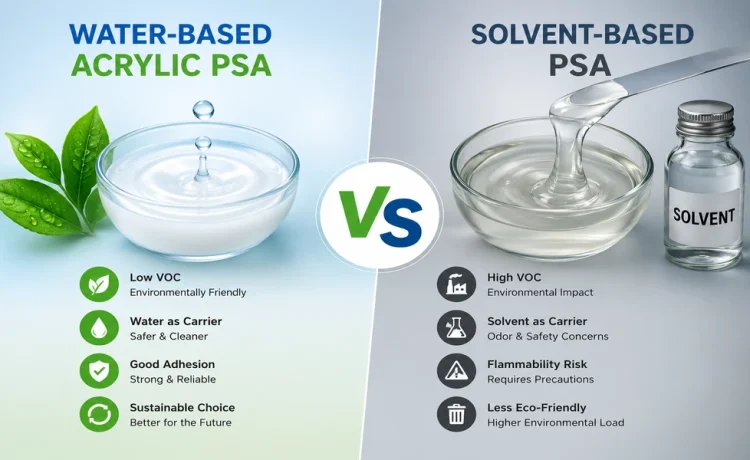
Selecting the right pressure-sensitive adhesive (PSA) is critical for the performance of protective films, industrial tapes, labels, and other surface protection products. Among the most common options, water-based acrylic PSA and solvent-based acrylic PSA each offer unique advantages depending on the application.
As manufacturers increasingly prioritize sustainability, product quality, and regulatory compliance, understanding the differences between these two adhesive technologies can help businesses make the right choice.
What Is Water-Based Acrylic PSA?
Water-based acrylic PSA is formulated with water as the primary carrier, replacing organic solvents traditionally used in adhesive systems. It provides instant adhesion under light pressure while offering excellent environmental performance and long-term stability.
Water-based acrylic PSAs are widely used in:
- PE and PET protective films
- Metal surface protection
- Glass protection films
- Industrial tapes
- Electronics applications
What Is Solvent-Based Acrylic PSA?
Solvent-based acrylic PSA uses organic solvents to dissolve acrylic polymers before coating and drying. These adhesives are known for their excellent chemical resistance and strong adhesion under demanding conditions.
They are commonly used in applications requiring:
- High chemical resistance
- Extreme temperature performance
- Outdoor durability
- Long-term permanent bonding
Water-Based Acrylic PSA vs Solvent-Based PSA
| Feature | Water-Based Acrylic PSA | Solvent-Based Acrylic PSA |
|---|---|---|
| VOC Emissions | Low | Higher |
| Environmental Impact | Excellent | Moderate |
| Odor | Low | Stronger |
| Workplace Safety | Better | Requires stricter solvent handling |
| Heat Resistance | Very Good | Excellent |
| UV Resistance | Excellent | Excellent |
| Aging Resistance | Excellent | Excellent |
| Custom Peel Strength | Easy to customize | Available |
| Protective Film Applications | Ideal | Suitable for specialty applications |
Advantages of Water-Based Acrylic PSA
Water-based acrylic PSA has become the preferred choice for many manufacturers due to its balance of performance and sustainability.
Key benefits include:
- Low VOC emissions
- Environmentally friendly formulation
- Excellent aging resistance
- Stable adhesion performance
- Clean removability
- Low odor during production
- Easy customization of peel strength
These advantages make water-based acrylic PSA particularly suitable for protective films used on stainless steel, aluminum, glass, and plastic surfaces.
Advantages of Solvent-Based Acrylic PSA
Solvent-based acrylic PSA still offers advantages in certain demanding environments.
These include:
- Higher resistance to aggressive chemicals
- Excellent performance at elevated temperatures
- Strong adhesion on difficult substrates
- Outstanding weather resistance
For applications exposed to harsh outdoor conditions or chemicals, solvent-based formulations may remain the preferred option.
Which Adhesive Is Better for Protective Film Manufacturing?
For most protective film manufacturers, water-based acrylic PSA offers the best overall value.
It combines:
- Stable adhesion
- Easy processing
- Low residue performance
- Sustainable production
- Compliance with modern environmental standards
In addition, water-based systems are easier to customize for different peel strengths, making them suitable for a wide range of substrates including stainless steel, aluminum, glass, PVC, and PET.
Choosing the Right PSA for Your Business
The ideal adhesive depends on your specific application and production requirements.
Water-based acrylic PSA is recommended if your priorities include:
Solvent-based acrylic PSA may be a better choice if your products require exceptional resistance to chemicals or extreme environmental conditions.