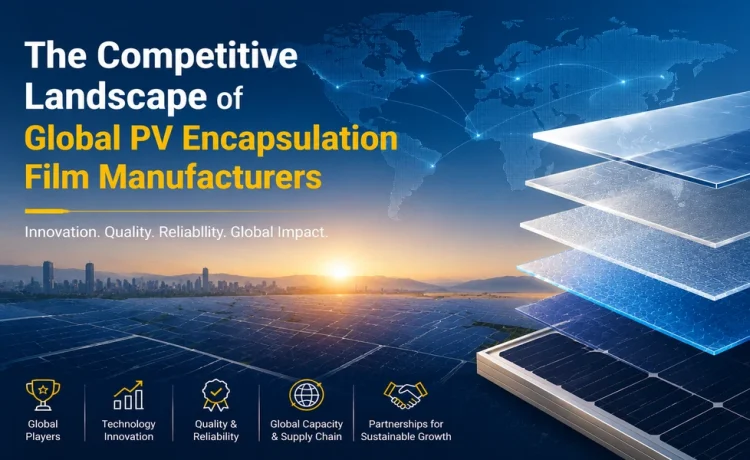
For decades, photovoltaic (PV) industry competition has focused primarily on solar cell efficiency, wafer technology, and module power output. However, as PV modules become more efficient and operate in increasingly demanding environments, encapsulation materials have become a critical factor determining long-term reliability, energy yield, and lifecycle performance.
PV encapsulation films, including EVA, POE, EPE, and emerging advanced polymer films, serve as the invisible protection layer between solar cells and the external environment. They must withstand decades of exposure to ultraviolet radiation, humidity, thermal cycling, mechanical stress, and chemical degradation.
As global PV installations continue expanding and advanced cell technologies such as TOPCon, HJT, BC, and perovskite tandem modules accelerate adoption, the competitive landscape of PV encapsulation film manufacturers is undergoing significant transformation.
Today, leading suppliers are competing not only on production capacity but also on material innovation, global supply capability, customization, and reliability validation.
1. Market Evolution
EVA (Ethylene Vinyl Acetate) has been the dominant encapsulation material for more than 40 years due to its excellent balance of cost, optical performance, adhesion, and manufacturing compatibility.
For conventional PERC modules, EVA solar panel film remains widely used because it provides:
- High optical transparency
- Strong adhesion between glass and cells
- Mature lamination processes
- Cost advantages
- Proven long-term reliability
However, the rapid development of N-type technologies has changed material requirements.
Modern high-efficiency cells introduce new challenges:
- Higher sensitivity to moisture and chemical migration
- Increased requirements for PID resistance
- Greater UV durability requirements
- Longer lifetime expectations
As a result, alternative materials have gained market attention:
POE (Polyolefin Elastomer)
POE solar panel film offers excellent moisture resistance and strong PID protection. It has become increasingly popular in TOPCon and HJT modules, especially for applications requiring enhanced reliability.
EPE (EVA-POE-EVA)
EPE solar film combines the advantages of EVA and POE. It provides moisture resistance close to POE while maintaining better process compatibility and cost efficiency.
TPO and Advanced Functional Films
New polymer systems are being explored for next-generation applications, including perovskite tandem modules and ultra-high reliability PV systems.
The market is therefore shifting from a single-material competition toward a diversified encapsulation ecosystem.
2. China Leads Global PV Encapsulation Film Manufacturing
China has become the global center of PV encapsulation film production, supported by its massive solar manufacturing ecosystem.
The competitive advantages of Chinese manufacturers include:
Large-Scale Production Capacity
The rapid expansion of global PV manufacturing has created strong demand for high-volume encapsulation film supply.
Leading Chinese suppliers have invested heavily in:
- Advanced extrusion lines
- Automated quality control systems
- Large-scale production facilities
- Integrated R&D laboratories
This enables manufacturers to support gigawatt-level module production requirements.
Strong Supply Chain Integration
China’s encapsulation film manufacturers benefit from close relationships with:
- Solar cell manufacturers
- Module producers
- Polymer suppliers
- Equipment manufacturers
This ecosystem allows faster product development and optimization.
Cost Competitiveness
Compared with overseas suppliers, Chinese manufacturers have achieved significant advantages in:
- Raw material procurement
- Manufacturing efficiency
- Production scale
- Supply chain management
These factors have helped Chinese PV encapsulation films become globally competitive.
3. Global Competitive Landscape
The global PV encapsulation film market can be divided into several competitive groups.
Large Integrated PV Material Suppliers
These companies typically have:
- Extensive production capacity
- Strong customer relationships
- Broad product portfolios
- Global manufacturing networks
Their advantages include reliability, scale, and the ability to supply major module manufacturers.
Technology-Focused Encapsulation Specialists
These companies compete through:
- Advanced polymer technologies
- Customized solutions
- High-performance products
Their focus is often on emerging applications such as:
- HJT modules
- BC technology
- Offshore PV
- Desert photovoltaic systems
- Floating solar
Regional Suppliers
Regional manufacturers compete through:
- Local service capabilities
- Faster delivery
- Customized support
They are particularly important for markets seeking localized PV supply chains.
4. Technology Innovation Determines Future Competitiveness
Production capacity alone is no longer enough. Future competition will increasingly depend on material innovation.
UV Resistance and Long-Term Durability
With PV projects expanding into harsh environments such as deserts and high-altitude regions, encapsulation films must provide superior UV protection.
Advanced films are being developed to reduce:
- UV-induced degradation
- Polymer aging
- Cell performance losses
Low Water Vapor Transmission Rate
Moisture protection is becoming increasingly important for:
- HJT modules
- TOPCon modules
- Bifacial modules
POE-based solutions are gaining attention because of their excellent barrier properties.
Compatibility with Next-Generation Solar Cells
Future encapsulation materials must adapt to:
- Ultra-thin silicon wafers
- Low-temperature processes
- Perovskite tandem structures
- Back-contact cell designs
Manufacturers with strong R&D capabilities will have a competitive advantage.
5. Global Manufacturing Networks Become a Key Differentiator
As photovoltaic supply chains become increasingly international, customers are placing greater importance on supplier stability.
Module manufacturers now consider:
- Production location
- Logistics efficiency
- Regional technical support
- Supply chain resilience
A global manufacturing footprint can reduce risks associated with:
- Transportation delays
- Regional trade policies
- Supply disruptions
Leading encapsulation film suppliers are therefore expanding production bases beyond China into regions such as Southeast Asia, Europe, and other strategic markets.
For example, companies with multiple manufacturing locations can provide localized support while maintaining global quality standards.
6. The Role of Quality Certification and Reliability Testing
PV modules are expected to operate for 25-30 years or longer. Therefore, encapsulation film manufacturers must demonstrate long-term reliability.
Important evaluation criteria include:
- IEC certification compliance
- PID testing
- Damp heat testing
- Thermal cycling testing
- UV aging testing
- Peel strength testing
Advanced manufacturers are also investing in:
- CNAS-certified laboratories
- Accelerated aging research
- Application simulation testing
Reliability data has become a major factor in supplier selection.
7. Future Outlook
The future competition among PV encapsulation film manufacturers will move beyond supplying basic films.
Leading companies will increasingly provide complete material solutions including:
As solar technology continues evolving, encapsulation materials will play a more strategic role in improving module lifetime, reducing degradation, and increasing energy output.
The winners in this market will not necessarily be the companies with the largest factories, but those that successfully combine: